
Unlocking the Magic of the Key Worker Model in Early Childhood Supports
Early childhood supports (also known as early childhood intervention) help children aged up to nine years with developmental delay or disability, and their families, to build the skills and confidence they need for everyday life.
At Everyday Independence, we deliver our Early Childhood Services (ECS) the Everyday Way. That means families can expect more than therapy — they can expect positive life change.
Our services are delivered through the key worker model — the NDIS’s preferred approach for supporting children and families. This model brings together paediatric occupational therapy, speech pathology, physiotherapy, positive behaviour support, and habit coaching under one coordinated plan. Families primarily work with one practitioner — their key worker — who delivers therapy and is their main point of contact for all services.
In this blog, we’ll explore how our key workers bring this model to life — helping children learn, grow, and thrive in the places they live, learn, and play.
Who is a Key Worker?
At Everyday Independence, our key workers are degree-trained teachers with practical experience and understanding of children’s development. They possess expertise in various fields, including education, social work, occupational therapy, speech pathology, and physiotherapy. They are highly trained in looking at a child’s and family’s needs from all angles, identifying any obstacles to developing everyday skills, building independence, and being fully included.
Key workers are distinct from Key Contacts who work in certain regions, such as Western Australia or South Australia. Key Contacts act as support coordinators, coordinating a participant’s therapy providers.
There are many benefits of using the key worker model to access NDIS early childhood supports, including:
- families have access to a team of practitioners with different skills and knowledge through one practitioner
- reduces the number of practitioners that a child and family need to get to know, making it easier to build a trusting relationship
- working with one practitioner who understands the family’s needs and goals enables consistent delivery of services to meet the child’s developmental needs
- reduces the stress of juggling appointments and services from multiple practitioners
- the needs of the whole family are considered, which better equips them to build on their strengths and make the positive changes needed to support the child’s development needs
This model is widely considered best practice in supporting a child’s developmental needs because it leads to better long-term outcomes for the child and family.
What is the Role of a Key Worker?
The role of a key worker is to plan, deliver and coordinate the family’s services on behalf of their broader team.
The key worker delivers therapy and draws on specialised expertise from other practitioners when needed.
They collaborate closely with the family to understand the child and the family’s priorities and aspirations. They then create a Child and Family Support Plan that outlines the specific strategies and services required to help the family achieve their outcomes. The key worker reviews this plan each year with the family, making any necessary adjustments to adapt to the child’s increasing abilities or changes in circumstances.
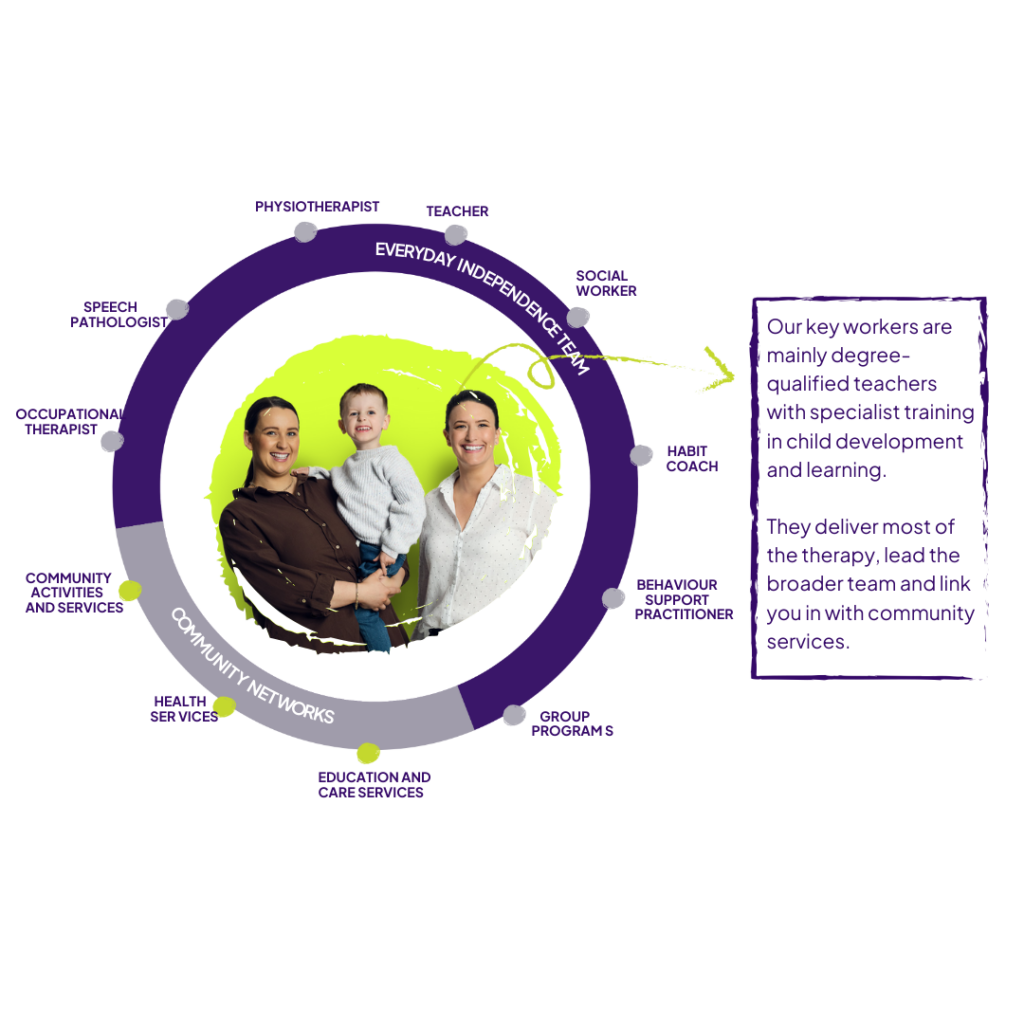
Our key workers provide a range of services, including:
- developing tailored strategies families can use in their daily routine to meet their child’s developmental needs
- arranging for services from other practitioners to support the child’s development
- offering intensive support to educate and empower those around the child with the necessary skills to support their learning, development and participation
- assisting to navigate the NDIS and other community services available for the family’s specific needs
- building the family’s abilities and confidence to advocate for their child’s best interests
- providing easily understandable information for the family can make informed decisions regarding their child’s needs
- connecting families with community-based services to help them meet their child’s developmental needs.
Where do Key Workers Deliver Services?
Our key workers deliver services in the places where the child spends their time. This includes home, kinder, school and other places in the community. Support delivered in these environments provides the best opportunity for children to learn and practice their new skills.
How to Access Our Early Childhood Supports
We have key workers working out of 40 therapy hubs across Australia. To support your client to make the positive life changes they desire, complete an online form or call us on 1300 179 131.
NDIS

Become part of the Everyday Independence community by joining our monthly newsletter to learn about latest news and events across Australia.
