Skip to Content

NDIS Positive Behaviour Support Caloundra

From communicating your needs, making choices, and having more control over your life, expect our team to help you do the things you want, your way.

At Everyday Independence, our Caloundra behaviour support practitioners understand that behaviour is often a response to an unmet need. As experienced behaviour support practitioners, we focus on identifying the underlying causes of challenging behaviours and developing strategies that reduce or eliminate them. So, you can live with greater independence, safety and choice.

Specialist Behaviour Support

Our team works closely with your therapy supports, family, and community services to ensure you have the consistent, coordinated support you need to reach your goals.

What to Expect With Caloundra NDIS Positive Behaviour Support

Our NDIS Positive Behaviour Support Caloundra services support children, teenagers, and adults with disabilities to build the skills and habits that matter most to them. Your positive behaviour support specialist will help you:

1. Understand the “why” behind behaviours

• Assess your abilities, environments, routines, and triggers
• Identify the underlying causes of challenging behaviours
• Ensure support is safe and consistent across all settings

2. Develop evidence-based Behaviour Support Plans

• An Interim Behaviour Support Plan is delivered within 30 days if restrictive practices are in place
• A Comprehensive Behaviour Support Plan is completed within 6 months
• All plans follow NDIS Commission guidelines for restrictive practices, reporting, and safeguarding

3. Build skills for everyday life

• Emotional regulation
• Communication and decision-making
• Routines, habits, and independence
• Social and community participation

4. Connect to essential services

Your Caloundra practitioner links you with mental health, family support, employment, or other community services that help you achieve your goals.

  • Assess your abilities and everyday environments to identify reasons for the use of challenging behaviours.
  • Use our findings to develop effective strategies to reduce challenging behaviours, which are outlined in an Interim Behaviour Support Plan and issued within 30 days of seeing you if there are restrictive practices in place, and a Comprehensive Behaviour Support Plan within 6 months.
  • Ensure that everyone who supports you understands your Behaviour Support Plan – triggers, interventions, and how to be consistent and safe in response to behaviours of concern.  
  • Build skills like emotional regulation and developing better habits and routines to increase independence and improve quality of life.
  • Connect with essential services like mental health, family support, employment, and more to help you reach your goals. 

Benefits of our NDIS Caloundra Positive Behaviour Support

By Your Side

Your practitioner is with you every step of the way, ensuring everyone supporting you is integrating personalised strategies into all aspects of your life and being consistent.

Connection to Services

We collaborate with schools, employers, therapists, support workers, mental health services, and community organisations to help you build confidence and independence.

Achieve Positive Change

Your Behaviour Support Plan is personalised to your strengths, goals, and daily life, integrating all the services you need to create meaningful outcomes.

How NDIS Positive Behaviour Support Caloundra Delivers More

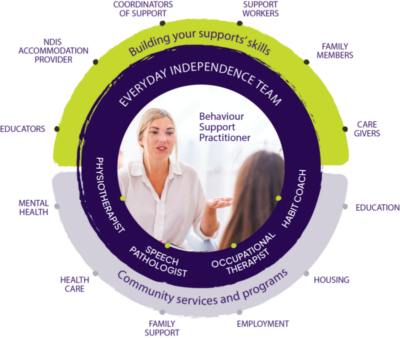
Everyday Independence uses a whole-of-life, team-based approach known as The Everyday Way.

Your behaviour support practitioner works alongside your full therapy team, supporting you in the places you live, learn, work, and spend time.

By bringing the right experts around you, across behaviour support, speech pathology, occupational therapy, physiotherapy, habit coaching, and more, we help you build the strategies and confidence to create long-term positive change.


Getting Started with NDIS Positive Behaviour Support

To get started with positive behaviour support in Caloundra, a behaviour support practitioner or your lead practitioner comes to your home to get to know you, your family and other members of your support team. They take a whole of life approach to set you on your pathway to positive change.

When you begin with our Caloundra positive behaviour support team, a behaviour support practitioner or lead practitioner visits your home to get to know you and your support network. We look at all areas of your life and create a clear path forward that supports your goals, safety, and independence.

Not yet a NDIS participant?

Visit our NDIS pages for information on getting your plan funded.

Frequently Asked Questions about Positive Behaviour Support

What is a Behaviour Support Plan?

The journey to enjoying more everyday life activities begins with creating an individualised Positive Behaviour Support (PBS) plan. We’ll collaborate with you and your trusted support team to ensure we’re all working towards a unified purpose, focusing on building capacity.

A PBS plan will be developed (within 30 days of your assessment if unauthorised restrictive practices are used) to share, review, and regularly update with your support team. On occasions where a restrictive practice is in place, the plan will be sent to the relevant states and territories’ Office of the Senior Practitioner for authorisation and the NDIS commission for monitoring the use of the restrictive practice.

We’ll help everyone involved understand the plan and how to use it in everyday life.

What are Restrictive Practices?

Restrictive practices are any interventions or practices that restrict the rights or freedom of movement of a person. They’re used in response to a behaviour of concern and should always be considered as a last resort. Sadly, they are being used to manage the behaviour of people with disabilities and can be extremely distressing. Our highly trained team of behaviour support practitioners are committed to reducing and eliminating the use of restrictive practices, so that people’s dignity and independence is regained, and quality of life is improved.

Under the NDIS, certain restrictive practices are regulated, which means they must be authorised by the State or Territory in which the person lives and monitored/ reported to the NDIS Commission of Quality and Safeguards. Restrictive practices Guide include chemical, physical, environmental, and mechanical restraints, and seclusion.

When Should I Consider Behaviour Support Services?

Behaviour support services should be considered if you or someone you care for uses challenging behaviours. These are behaviours that are unexpected and may lead to others around the person feeling frustrated, distressed or fearful.

We promise to help improve the person’s quality of life and those who support them. This includes developing the skills of those supports so that the person’s needs are met and they have the opportunities to make meaningful social connections and participate in the activities they enjoy.

How do I Get Started with Positive Behaviour Support?

To get started with positive behaviour support, your NDIS plan must include Improved Relationships (IR) funding. If you have IR funding, simply fill out an online form to tell us a bit about you, where you live and what your goals are so that we can match you to the right team.

A practitioner will then do an initial assessment at your home to understand your goals and get to know you, your family and other support team members.

After they gather all the information they need, the disability practitioner will pull together your dedicated therapy team.

Your follow-up appointments or focused assessments will help to develop specific strategies to reduce behaviours of concern and may include occupational, speech, and physiotherapies, assistive technologies, and/ or social intervention. One or two of these team members may attend the assessment depending on your immediate goals.

This approach ensures you get the best value from your NDIS funding.

Who are Everyday Independence Support Practitioners?

Our behaviour support practitioners are curious about behaviours and understanding why people use challenging behaviours. They are occupational therapists, mental health nurses, registered nurses, psychologists, social workers, behavioural/social scientists or Social Science and developmental educators who work to change attitudes, expectations and outcomes so that people with disability can live a much better life.

They have been selected for their skills and qualities, and they offer exceptional  evidence-based therapy support with compassion and an open mind.

A Team Approach for Positive Change

Occupational Therapy for Children

Caloundra Occupational Therapy

Speech Pathology for Children

Caloundra Speech Pathology

Physiotherapy for Children

Caloundra Physiotherapy

NDIS Early childhood intervention services Launceston

Caloundra Early Childhood Supports

Habit Coaching Outer Eastern Melbourne

Caloundra Habit Coaches

Elliot’s Path Through Play

Elliot has grown in his confidence and abilities through his love of play.

Read my story

Leigh’s First Job Opportunity

Leigh recently started her first part-time job at Subway – an exciting milestone for her.

Read my story

Jason Speaks Up For Inclusion

Jason works on speech fluency and strategies to manage challenging interactions, building confidence in the community.

Read my story
Sign up to our newsletter

Become part of the Everyday Independence community by joining our monthly newsletter to learn about latest news and events across Australia.