NDIS Registered Provider — Positive Behaviour Support Across Adelaide— Children, Teens, Adults
Looking for an Adelaide Behaviour Support Practitioner?
Everyday Independence provides NDIS positive behaviour support across Adelaide for children, teenagers and adults. As a community-based provider, our Adelaide behaviour support practitioners deliver support in your home, school, workplaces and community.
By working where everyday life happens, we gain a deeper understanding of the factors influencing behaviours of concern. We work alongside you to build practical skills and make changes to your environment to reduce those behaviours and improve your quality of life.
With expertise across social work, occupational therapy, mental health, and developmental education, our behaviour support practitioners provide services including:
Assessing your strengths, support needs and everyday environments to understand why and when behaviours of concern occur
Developing a personalised Behaviour Support Plan with practical strategies to reduce behaviours of concern.
If restrictive practices are in place, we’ll provide an Interim Behaviour Support Plan within 30 days and a Comprehensive Behaviour Support Plan which incudes a Functional Behaviour Assessment) within six months.
Supporting you, your family and support team with practical strategies to create safer, more supportive environments and reduce the need for restrictive practices.
Building skills such as emotional regulation, communication, routines and independence to improve quality of life.
Bringing together the right therapists, community services and supports to help you achieve your goals. For children under nine years, this includes working alongside an early childhood key worker.
NDIS Behaviour Support Plans
As part of your NDIS behaviour support, we develop structured plans that guide your support team and create clear, consistent strategies. This includes:
An Interim Behaviour Support Plan (within 30 days) focused on safety, immediate needs and reducing restrictive practices
A Comprehensive Behaviour Support Plan (within 6 months) developed with you and your support network
These plans:
Identify the underlying causes of behaviours
Provide practical, evidence-based strategies
Align everyone involved in your support
Create more opportunities for positive experiences in everyday life
Ready to Start Positive Behaviour Supports?
Who are you seeking services for? Select an option below to begin your enquiry.
Adelaide Positive Behaviour Support for Every Stage of Life
Behaviour Support for Children in Adelaide
We support children to better understand their behaviours and build the foundations for communication, emotional regulation and positive experiences.
This may include:
Understanding the triggers and reasons behind behaviours of concern
Supporting emotional regulation and early communication skills
Providing practical behaviour support strategies for families and carers
Building consistent routines and positive daily experiences
Reducing or eliminating restrictive practices to improve participation at home, school and in the community.
We work closely with families and support networks so everyone feels confident and aligned in how to support the child.
Behaviour Support for Teenagers
Adolescence can bring increased expectations, independence and emotional complexity. We support teenagers to navigate this stage with confidence and the right strategies in place.
This may include:
Understanding behaviours linked to frustration, communication or changing environments
Developing practical strategies to reduce behaviours of concern
Building independence, resilience and self-awareness
Supporting families and schools to respond consistently
Creating more opportunities for positive experiences and social connection
Where needed, we also support transitions, helping young people move toward greater independence, education or employment pathways.
Behaviour Support for Adults
For adults, positive behaviour support focuses on increasing independence, choice and quality of life.
This may include:
Understanding and reducing behaviours of concern
Implementing practical, personalised behaviour support strategies
Reducing restrictive practices and increasing access to the community
Supporting daily routines that promote wellbeing and independence
Building the capability of support teams to provide consistent, effective support
We focus on what matters most to you. Supporting greater control, participation and meaningful engagement in everyday life.
One Team That Comes to You
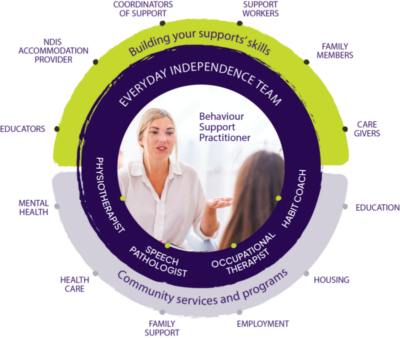
Many NDIS participants benefit from support from more than one therapist. Using insights from your assessment, we’ll bring together the right Everyday Independence therapists to deliver targeted support across all areas of your life.
This may include occupational therapists, speech pathologists, physiotherapists, habit coaches, employment coaches, early childhood practitioners, and youth practitioners.
In Adelaide’s north, we work in everyday community settings such as Parabanks Shopping Centre, local parks and public transport routes like the Adelaide Metro, helping build confidence and independence in real-world environments. We also support people across a range of settings, from Glenelg to Botanic Park, where practising skills in the moment supports communication and emotional regulation.
Across Adelaide’s southern suburbs, from Marion and Morphett Vale to Noarlunga, Seaford and Hallett Cove, we focus on practical, real-life strategies that reduce behaviours of concern and safely minimise restrictive practices over time.
We provide therapy services and youth employment and vocational supports to people with disabilities living in metro areas of Northern Adelaide, Southern Adelaide, Eastern Adelaide, Western Adelaide and out to the Barossa.
NDIS Adelaide Occupational Therapy
NDIS Adelaide Speech Pathology
NDIS Adelaide Physiotherapy
NDIS Adelaide Early Childhood Supports
NDIS Adelaide Habit Coaches
Adelaide NDIS Youth Employment and Vocational Services
Youth Supports
Positive Behaviour Support Frequently Asked Questions
What are behaviours of concern?
Behaviours of concern, are defined as behaviours that:
Put you or others at risk of harm (physical, emotional or psychological)
Limits your access to community activities, education, and support services
Or significantly impacts your quality of life in various ways.
For example, you might find it hard to control your reactions, present aggression and socially disruptive behaviour (e.g. screaming, verbal aggressions, physical aggression), run away, cause property damage or not be able to follow routines. These behaviours can stop you from learning new things, connecting with others or enjoying your day-to-day living.
What is the current waitlist for Positive Behaviour Support in Adelaide?
We regularly have immediate capacity or no waitlists for positive behaviour supports so you can start straight away. See our service availability here
Does Everyday Independence provide mobile PBS services in northern and southern Adelaide?
We have mobile behaviour support practitioners working across northern Adelaide, Central Adelaide and Southern Adelaide. We cover areas including Mile End, Salisbury, and Morphett Vale, Mount Barker and many more.
What funding is needed to access behaviour support services in Adelaide?
NDIS participants with Improved Relationships or Behaviour Supports funding in their NDIS plan can access this service. Children, teenagers and adults with disability in Adelaide with Improved Daily Living funding can access our Improved Daily Living Programs. These programs help reduce behaviours of concern and develop healthier habits.
Can I access behaviour support if I only have ‘Improved Daily Living’ (IDL) funding?
You need Improved Relationships or Behaviour Supports funding in your NDIS plan to access specialist positive behaviour support. We offer Improved Daily Living Programs which help people with moderate behaviors to build health sustainable habits.
What is a behaviour support plan?
A behaviour support plan includes strategies to understand behaviours, reduce restrictive practices and support consistent approaches across home, school and community.
A PBS plan will be developed (within 30 days of your assessment if unauthorised restrictive practices are used) to share, review, and regularly update with your support team. On occasions where a restrictive practice is in place, the plan will be sent to the relevant states and territories’ Office of the Senior Practitioner for authorization and the NDIS commission for monitoring the use of the restrictive practice.
We’ll help everyone involved understand the plan and how to use it in everyday life.
Who are Everyday Independence Behaviour Support Practitioners?
Our behaviour support practitioners are highly trained and experienced in supporting children, teenagers and adults who use behaviours of concern.
Our team brings diverse expertise across social work, occupational therapy, mental health, and developmental education. Carefully selected for their skills, values and approach, they provide compassionate, open-minded support grounded in evidence-based practice.
At Everyday Independence, our practitioners engage in ongoing training and professional development to deliver person-centred positive behaviour support.
What are restrictive practices?
A restrictive practice limits a person’s rights or freedom of movement. People typically use them in response to behaviours of concern, and they should always be a last resort. There are five types of regulated restrictive practices, these include chemical, physical, environmental, and mechanical restraints, and seclusion.
Our behaviour support practitioners work hard to reduce or eliminate restrictive practices. They aim to restore the person’s dignity and independence. their goal is to improve the person’s quality of life.
Under the NDIS, some restrictive practices are regulated. They must be authorised by the respective States or Territory, with monitoring and reporting to the NDIS Commission of Quality and Safeguards.
How does Everyday Independence help eliminate regulated restrictive practices?
We focus on reducing and eliminating restrictive practices by understanding the reasons behind behaviour and building safer, more positive alternatives. Our team develops practical strategies that support communication, emotional regulation, and participation in everyday life. We work closely with families and support teams, while meeting NDIS requirements, to ensure any restrictive practices are regularly reviewed, reduced, and only used as a last resort.
Where can I read more about restrictive practices?
Do Behaviour Support Practitioners write Outcome Reports?
Yes, we report on the outcomes the participant has achieved with the funding utilised, including any barriers and outlining what’s needed in the next NDIS plan to achieve their desired outcomes.
How quickly can an Interim Behaviour Support Plan be developed if restrictive practices are involved?
If restrictive practices are in place or being considered, Everyday Independence will develop an Interim Behaviour Support Plan within 30 days.
This plan focuses on immediate safety, reducing and eliminating restrictive practices where possible, and putting the right supports in place straight away. Our team works with you and the people around you to make sure there is a clear, practical plan that can be used in everyday life while longer-term strategies are developed.
Does your Adelaide team support adults with complex psychosocial disabilities?
Yes. Our Adelaide team supports adults with complex psychosocial disabilities through a coordinated, team-based approach. We focus on building everyday life skills, emotional regulation, and community participation.
Your team works alongside you, your family, and supports like recovery coaches to ensure everything is aligned, practical, and focused on creating positive change in your everyday life.
Are you recruiting Behaviour Support Practitioners?
Everyday Independence is always looking for practitioners who are curious about behaviours and understanding why people use behaviours of concern. We’re currently recruiting occupational therapists, speech pathologists, mental health nurses, developmental educators, psychologists, and social workers to support people with disabilities to live a much better life.
Will my behaviour support practitioner visit my child’s school in Adelaide?
Yes. Your behaviour support practitioner can visit your child’s school in Adelaide to see how they learn, interact, and respond in that environment. This helps us understand what’s working and where support is needed. We work closely with teachers and school staff to develop practical strategies that can be used every day, so your child is supported consistently across home, school, and the community.
Can you provide PBS for children under nine via the Early Childhood Approach?
Yes. We provide Positive Behaviour Support for children under nine through the Early Childhood Approach using a Key Worker model. Your key worker works closely with your family and supports your child’s development across everyday routines. Behaviour support is integrated into play, communication, and daily activities, with a focus on building skills, reducing behaviours of concern, and supporting participation at home, childcare, and in the community.
Do you collaborate with my existing Adelaide-based support coordinators and carers?
Yes. We work closely with your existing support coordinators, carers, and broader team in Adelaide to ensure everyone is aligned. Your practitioner communicates regularly, shares strategies, and helps coordinate supports so they work together in everyday life. This team-based approach reduces duplication, builds consistency, and keeps everyone focused on your goals and the outcomes that matter most to you.
AAC: Supporting Dianne’s Communication
Learn how Dianne explored augmentative and alternative communication, including an iPad app and printed keyboard, for conversations and appointments.